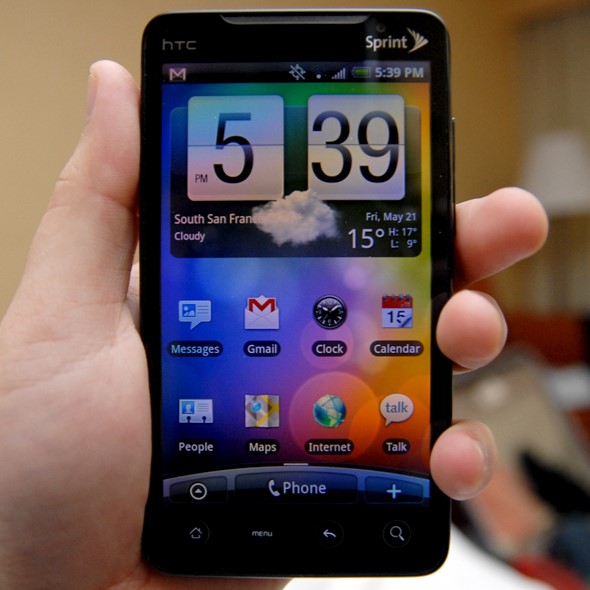
HTC's branded interface for Android (and also for Windows Mobile 6.5 on the HD2 and Brew on the HTC Smart), introduced on June 24, 2009 together with the HTC Hero. It grew out of TouchFLO (2007) and TouchFLO 3D (2008). Its principles were "Make it mine, Stay close, Discover the unexpected": a large flip clock with weather, Scenes (desktop profiles), Friend Stream (a social network aggregator) and Leap (a pinch-to-overview of screens). Versions: 1.0 (Hero), 2.0 (Desire HD, HTCSense.com), 2.1 (Desire S), 3.0 (Sensation: 3D carousel, lock ring), 3.5/3.6, 4.0 (One X: slimmed down, ImageSense, Beats), 4+ (One X+), 5.0 (One M7: BlinkFeed, Zoe, flat design, a clock without the "flip"), 5.5, 6.0 (One M8: Motion Launch, color themes), 7.0 (One M9: Themes, the Sense Home location widget), 8.0 (HTC 10: Freestyle Layout, Boost+, no more duplicating Google apps), 9 (U11: Edge Sense, Sense Companion) and 10 (U12+). With the Desire 20 Pro (2020), HTC moved to near-stock Android with a few separate apps (HTC Camera, Edge Sense). See [[tech]] for more.
Specifications
| Debut | June 24, 2009, HTC Hero |
|---|---|
| Predecessor | TouchFLO (2007), TouchFLO 3D (2008) |
| Latest version | Sense 10 (U12+, 2018) |
| Key features | flip clock, Scenes, Friend Stream, BlinkFeed, Zoe, Motion Launch, Themes, Freestyle Layout, Edge Sense |
| Fate | replaced by near-stock Android from 2020 |
Data from Wikipedia (en)
| Released | 2009-06-24 |
|---|
From Wikipedia
HTC Sense is a software suite and a user interface developed by HTC, used primarily on the company's Android-based devices. HTC Sense, the successor to HTC's TouchFLO 3D, enhances Android with a revamped home screen, keyboard, widgets and HTC apps. The first device with Sense, the HTC Hero, was released in 2009. The HD2 running Windows Mobile 6.5, released later the same year, included Sense.
Source: HTC Sense — Wikipedia (CC BY-SA 4.0)
Related models
Section: Brands and Subsidiaries · Brands and companies: 2009