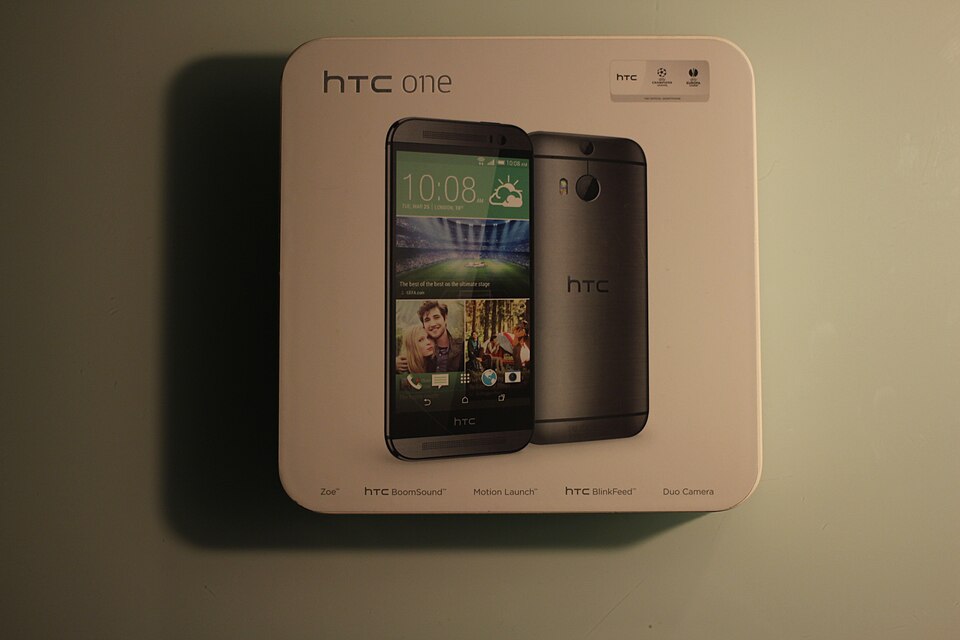
Presentato il 25 marzo 2014 a Londra e New York, in vendita lo stesso giorno presso Verizon e una settimana dopo ovunque. Scocca al 90% in alluminio con retro arrotondato e finitura opaca/lucida (Gunmetal Gray, Glacial Silver, Amber Gold), Super LCD3 1080p da 5,0" con Gorilla Glass 3, tasti su schermo, Snapdragon 801 a 2,3 GHz (2,5 in Asia), 2 GB di RAM, 16/32 GB + microSD fino a 128 GB, 2600 mAh. Duo Camera: la principale UltraPixel da 4 MP (senza OIS) più una seconda fotocamera di profondità per gli effetti UFocus (rimessa a fuoco), Foregrounder e Dimension Plus; frontale da 5 MP. BoomSound più potente del 25%, Sense 6 con Motion Launch (gesti a schermo spento), Extreme Power Saving Mode, porta IR. 160 g, 9,35 mm. Android 4.4.2 → 6.0 Marshmallow (Sense 7). Custodia Dot View. Ottenne i voti migliori tra tutti gli HTC (90+ nella maggior parte delle recensioni) e fu l'ultima ammiraglia davvero di massa. Varianti: Google Play Edition, Harman/Kardon Edition (Sprint), One (M8) for Windows (Windows Phone 8.1, Verizon/AT&T/T-Mobile), One (M8) Eye (Duo da 13 MP, Asia), One (E8) in plastica, One (M8s) del 2015 con Snapdragon 615 e 13 MP.
Caratteristiche
| SO | Android 4.4.2 → 6.0 + HTC Sense 6 → 7 (for Windows: WP 8.1) |
|---|---|
| Processore | Qualcomm Snapdragon 801 MSM8974AB, 4×2,3 GHz, Adreno 330 |
| RAM | 2 GB |
| Memoria | 16 / 32 GB + microSD fino a 128 GB |
| Display | 5,0" 1920×1080 Super LCD3, 441 ppi, Gorilla Glass 3 |
| Fotocamera | 4 MP UltraPixel f/2.0 + sensore di profondità (Duo Camera), 1080p; frontale da 5 MP f/2.0 |
| Audio | BoomSound di seconda generazione |
| Connettività | LTE Cat 4, Wi-Fi ac, Bluetooth 4.0, NFC, porta IR, DLNA, MHL |
| Batteria | 2600 mAh, Quick Charge 2.0 |
| Dimensioni | 146,4×70,6×9,35 mm, 160 g |
| Nome in codice | M8 |
Dati da Wikipedia (en)
| Produttore | HTC |
|---|---|
| Serie | HTC One |
| Nome in codice | M8 |
| Uscita | 2014-03-25 |
| Disponibilità | 2014-03-25 |
| Tipo | Touchscreen smartphone |
| Formato | Slate |
| SO | Original: Android 4.4.2 "KitKat"; Last official: Android 6.0 "Marshmallow"; Latest: Android 14 via LineageOS |
| SoC | Qualcomm Snapdragon 801 |
| Processore | 2.26 GHz quad-core (MSM8974ABv3); 2.45 GHz quad-core (MSM8974ACv3) |
| GPU | Adreno 330 550/578 MHz |
| RAM | 2 GB LPDDR3 RAM |
| Memoria | 16 or 32 GB flash |
| Scheda di memoria | microSD up to 128 GB |
| Display | 5.0 in Super LCD 3 with RGB matrix; 1920 x 1080 pixels (16:9 Aspect ratio) (441 ppi); Corning Gorilla Glass 3.0 |
| Fotocamera posteriore | 4.0-megapixel; 2.0 μm camera with autofocus, UltraPixel BSI image sensor, dual-LED dual tone flash, F2.0 aperture, 28 mm lens, continuous shooting, 2.0-megapixel depth of field sensor. |
| Fotocamera frontale | 5.0-megapixel, 2.0 μm camera, BSI image sensor |
| Batteria | 2,600 mAh Li-po battery |
| Dimensioni | 146.4 mm H ; 70.6 mm W ; 9.4 mm D |
| Peso | 160 g |
| Predecessore | HTC One (M7) |
| Successore | HTC One M9 |
| Correlati | HTC One Mini 2 |
| Sito | http://www.htc.com/www/smartphones/htc-one-m8/ |
Da Wikipedia
L'HTC One (M8) è uno smartphone top di gamma prodotto dall'azienda taiwanese HTC, presentato ufficialmente il 25 marzo 2014.
Fonte: HTC One M8 — Wikipedia (CC BY-SA 4.0)
Wikipedia (en)
The HTC One (M8) is an Android or Windows smartphone manufactured and marketed by HTC. Following a number of leaks that occurred during the months prior, the device was officially unveiled in a press conference on March 25, 2014, and released the same day by Verizon Wireless at retail, and by other Canadian and United States carriers for online orders prior to its wider retail availability in mid-April.
Source: HTC One (M8) — Wikipedia (CC BY-SA 4.0)
Modelli correlati
Anche nel 2014
 Google Nexus 9 (HTC, 2014)Per Google
 HTC Desire 310 (V1)Serie Desire
 HTC Desire 610 (A3)Serie Desire
Sezione: Serie HTC One (2012–2016) · Catalogo modelli: 2014